
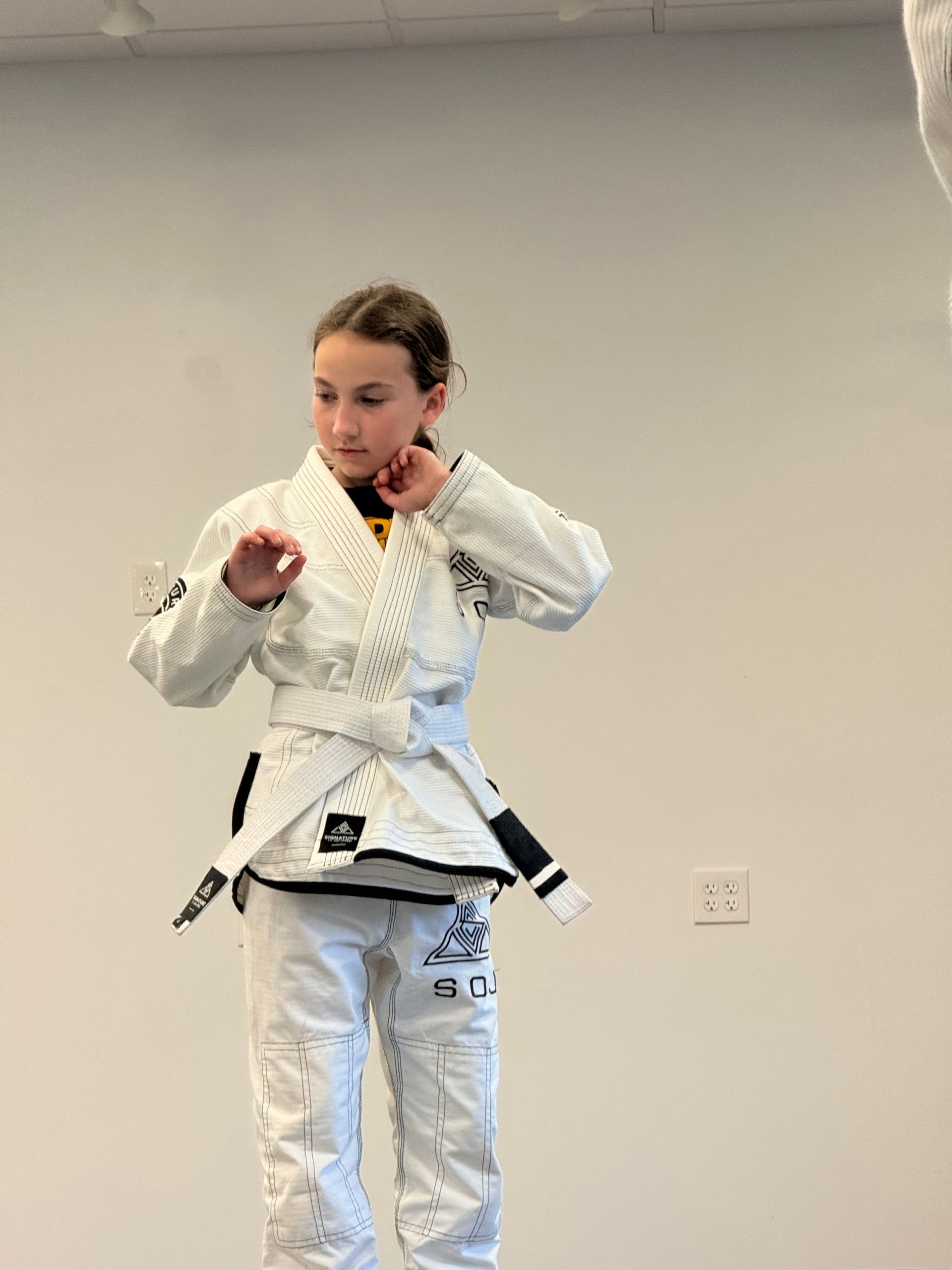
Youth Jiu-Jitsu turns movement into a skill-building lab where kids practice fitness, focus, and calm decision-making.
Belmont parents often want more than an after-school activity that just burns energy. You want something that helps your child move better, listen better, and feel more capable in everyday situations, without turning the room into chaos. Youth Jiu-Jitsu can be a great fit for that, because progress is built on habits: showing up, paying attention, trying again, and learning how to work with a partner.
In our Youth Jiu-Jitsu classes, we treat training as whole-child development. Yes, Brazilian Jiu-Jitsu has practical self-defense roots, but what most families notice first is how quickly kids start picking up routines that support physical fitness and mental focus. We stay realistic, too: every child responds differently, and research in youth BJJ is still developing, so we talk in terms of what training can help develop, not what it guarantees.
This guide is here to answer the practical questions we hear in Belmont all the time: what happens in a typical class, how we keep kids safe, how focus shows up on the mat, and what you can do to help your child have a great first day.
Youth Jiu-Jitsu in Belmont: what kids actually do in class
When parents picture a martial arts class, it is easy to imagine nonstop sparring. That is not how we build beginners, and it is not how we keep classes productive. A well-run Youth Jiu-Jitsu session usually follows a predictable rhythm, which helps kids feel secure and helps instructors coach clearly.
A typical class flow (and why it matters)
We usually start with age-appropriate movement that looks simple at first, but has a purpose. Shrimping, bear crawls, rolls, balance drills, and partner movement games build coordination without needing a lecture. Kids learn how their bodies move on the ground, which is a big part of Brazilian Jiu-Jitsu.
Next comes technique. We teach one concept at a time, then we repeat it with coaching. Repetition is where focus grows, because kids have to notice small details: where their hands are, where their knees are, how their hips turn, and how to keep pressure controlled. Finally, we add structured partner practice and, when appropriate, carefully supervised live training with clear rules.
“Focus through movement” in plain terms
Focus is not a motivational speech, it is a behavior. In Youth Jiu-Jitsu, we can see focus when your child:
• Listens for a specific cue and moves right away
• Remembers a two or three step sequence without rushing
• Waits for a partner to reset instead of powering ahead
• Notices position changes and adjusts calmly
• Stops immediately when an instructor calls time
Those are small wins, but they stack up. Kids start learning that attention is something they can practice, not just something they either have or do not have.
Physical benefits: fitness that feels like play, but builds real ability
Kids do not need another workout that feels like punishment. The best youth training builds athletic skills while still feeling fun and social. Youth Jiu-Jitsu is naturally physical, but it is not just random wrestling. There is a lot of structured movement that develops broad fitness qualities.
Coordination, balance, and body control
Brazilian Jiu-Jitsu asks kids to move in unusual ways: turning their hips, framing with their arms, building a base from their knees, and staying balanced while a partner pushes or pulls. That develops proprioception, the sense of where the body is in space. For many children, especially beginners, improved balance shows up quickly because the training gives them so many chances to practice it.
Strength and endurance, without treating kids like small adults
BJJ uses controlled resistance, not max lifting. Kids build grip strength, core stability, and muscular endurance through drills and partner games that match their age and maturity. We keep expectations realistic and technique-first. If a child is growing fast, uncoordinated for a while, or just not naturally “sporty,” we coach the basics patiently until movement starts to click.
Mobility and safe falling skills
Youth Jiu-Jitsu includes learning how to land, roll, and recover position. That matters because kids fall in real life, too, on playgrounds and in sports. We teach safe movement patterns progressively, and we make sure children understand how to protect themselves and their partners during transitions.
Mental benefits: attention, patience, and emotional control under pressure
Parents often ask if Youth Jiu-Jitsu helps with focus. The honest answer is that it can, and there are promising research summaries linking youth BJJ and martial arts participation with improvements in self-control, inhibitory control, and reduced distractibility, but the overall evidence base is still limited and not definitive.[7] We think the more useful point is this: the class constantly gives kids a reason to practice focus, because the game changes second by second.
Problem-solving that rewards calm, not chaos
BJJ is often described as physical chess, and that is not just a catchy phrase. Kids learn positions with clear goals: escape, stabilize, improve, submit, or reset. When a plan fails, we coach them to try a different option rather than panic. Over time, that practice can support resilience, because kids get used to the idea that getting stuck is part of learning, not a sign they are bad at it.
Self-control that has a real-world “stop button”
One of the most important mental skills in a Brazilian Jiu-Jitsu class in Belmont is learning when to stop. Kids learn to “tap” to signal discomfort, and we teach partners to release immediately. That builds trust and a culture of control. It also reinforces a message parents appreciate: strength is not the same as intensity, and control is the goal.
Confidence built through competence, not intimidation
Confidence is not just hype. It is what happens when a child realizes, “I can do hard things, and I can keep my cool.” A 2025 study focused on life skills and BJJ reported strong parent-perceived improvements in children’s confidence, commitment, respect, and transfer of skills beyond the gym, including 96.4 percent agreement for confidence and 96.4 percent for life-skill transfer.[4] Parent reports are not the same as clinical proof, but the pattern matches what we aim for: steady progress, earned wins, and respectful coaching.
Social development: cooperation, respect, and handling setbacks
Even though Jiu-Jitsu is an individual skill, kids train together. That means every class is also a social skills workshop, just without the awkward worksheets.
Partner etiquette and respectful habits
We teach kids how to line up, take turns, and work with different partners. That matters in Belmont families where kids come from many backgrounds and activity levels. Youth Jiu-Jitsu in Belmont works best when the culture is consistent: be kind, be safe, be coachable. Respect is not a slogan; it is how you grip, how you speak, and how you respond when an instructor corrects you.
Learning to lose small, so kids do not fear big challenges
Every child gets stuck sometimes. That is normal. We frame those moments as data: “What happened? Where was your base? What could you try next time?” A youth martial-arts intervention with 26 sessions reported improvements in positive social behavior and reductions in negative social behavior compared with a control group.[7] We cannot claim any single program guarantees that outcome, but we can say this: training gives kids structured practice in handling frustration while staying respectful, and that skill matters off the mat.
Safety and age-appropriate training: what we do and what you should ask
Safety is not an afterthought in Youth Jiu-Jitsu. It is the foundation that allows kids to learn confidently. Grappling is a contact sport, so we address risk directly and manage it with smart structure.
How a responsible youth program reduces risk
We focus on prevention first: good coaching, clear rules, and progressive training. We also distinguish between recreational learning and intense competition preparation, because the demands are different. A 2025 analysis of youth jiu-jitsu competition rules noted limited scientific guidance for gradual physical, technical, and tactical development, which reinforces the need to be careful about how intensity increases over time.[3]
Here is a practical parent checklist you can use when you visit a class:
• Qualified instruction with clear boundaries around takedowns, submissions, and speed
• Progressive skill development where kids earn more intensity by showing control
• Partner matching by size, maturity, and experience, not just by age
• Hygiene procedures that reduce skin infection risk, including mat cleaning and clean uniforms
• Supervision during live training, plus clear rules for tapping, stopping, and resetting
• Policies for pain, injury, illness, and suspected concussion, including when kids should sit out
We also encourage you to talk with us about anything that affects training: past injuries, sensory sensitivities, anxiety, attention challenges, or concerns about rough play. The more we know, the better we can coach your child safely.
Recreational training versus competition: keeping goals healthy
Many Belmont families want a positive routine, not a tournament calendar. Youth Jiu-Jitsu can support either path, but the approach should be intentional.
Recreational students: skill, fitness, and confidence
Recreational training emphasizes fundamentals, movement quality, and controlled partner work. Kids learn how to spar lightly and safely, but the goal is not to “win the room.” It is to improve week by week.
Competition: optional, gradual, and child-centered
Competition can be motivating for some kids, but it should be introduced carefully. We keep it optional and based on readiness, not pressure. If your child is curious, we talk about what competition involves, how to prepare safely, and how to keep the experience positive. The point is growth, not labels.
Before your first class: how to set your child up for success
Starting something new can feel big for a kid, even if your child is excited. A little preparation makes the first Youth Jiu-Jitsu class smoother.
1. Check the class schedule and confirm the right age group and format for your child.
2. Tell us about injuries, medical restrictions, or concerns about contact before class starts.
3. Arrive early for orientation so your child is not rushing onto the mat.
4. Bring water, trim fingernails and toenails, and remove jewelry.
5. Make sure training clothes are clean, secure, and free of hard or sharp pieces.
6. Please do not train with fever, contagious illness, or uncovered skin infections.
7. Remind your child that tapping and speaking up are always allowed and always respected.
If your child is shy, anxious, highly energetic, or easily frustrated, that is not a deal-breaker. It just changes how we introduce the room. Some kids start by observing, then drilling, then light sparring once trust is built. We would rather go slow and do it right than rush a child into intensity.
Frequently asked questions from Belmont parents
Is Youth Jiu-Jitsu safe?
It can be safe when classes are age appropriate, supervised, and built around control. We use progressive training, partner matching, and clear rules for tapping, stopping, and respectful contact. No contact sport is risk-free, so we take prevention seriously and communicate policies clearly.
Does my child need athletic experience?
No. Many kids start with zero background. We teach movement fundamentals, basic positions, and partner etiquette before expecting advanced technique or hard sparring.
Will Brazilian Jiu-Jitsu make my child aggressive?
Our goal is calm problem-solving and responsible control, not aggression. We coach kids to respect partners, follow rules, and separate sport practice from real-world conflict.
Can this help with focus?
BJJ naturally requires listening, remembering sequences, and making decisions while moving. Research summaries suggest possible improvements in self-control and inhibitory control, but evidence is still developing, so we avoid promising guaranteed outcomes.[7]
How often should my child train?
For many beginners, one or two classes per week is a solid start. Frequency depends on age, recovery, interest, and your family schedule.
Take the Next Step
If you want an activity that blends movement, structure, and real skill-building, our youth program is designed to make that process clear and supportive from day one. We focus on safe fundamentals, steady progress, and a class culture where kids learn to train with control, not ego.
When you are ready, we will help you choose the right starting point based on your child’s age, temperament, and experience. That is exactly how we run Youth Jiu-Jitsu at Signature of Jiu-Jitsu in Belmont: practical coaching, consistent expectations, and a welcoming place to learn.
Improve your fitness, build confidence, and develop your Jiu-Jitsu skills at Signature of Jiu-Jitsu.